Xylo Fix Roofers logo
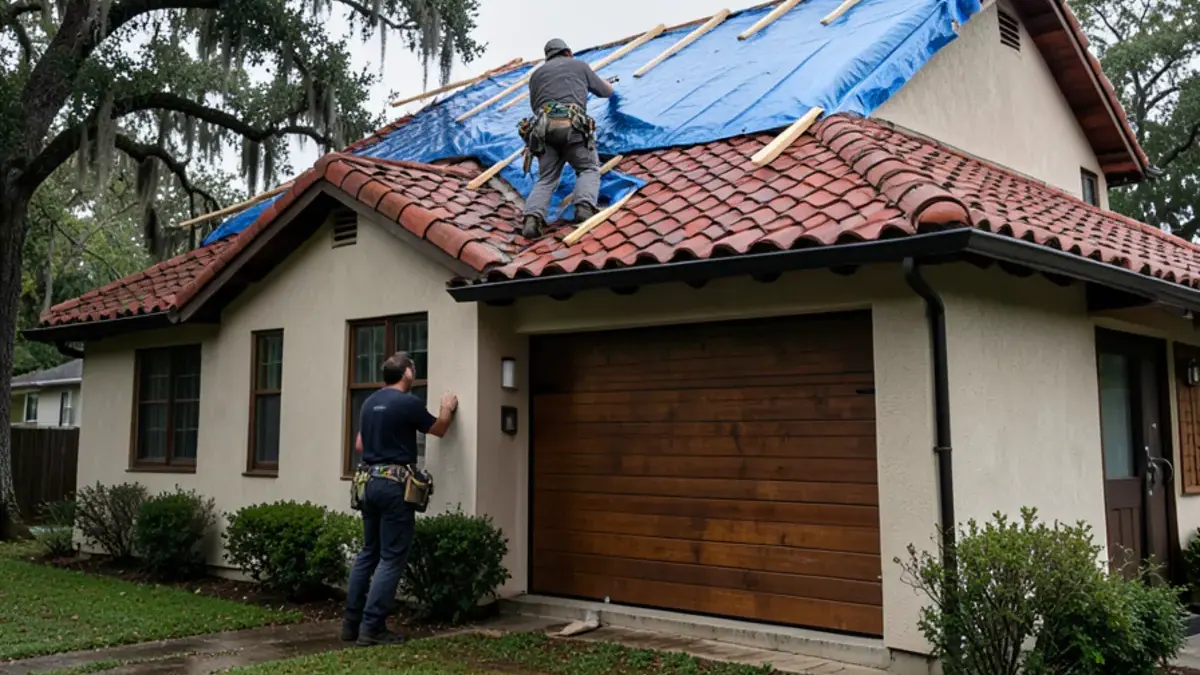
Emergency roof tarping in Campbell, CA: tarp anchored with boards over a Spanish tile roof

Emergency Roof Repair

Emergency Roof Tarping in Campbell, CA

Emergency roof tarping in Campbell, CA covers a damaged roof temporarily so rain stays out until the permanent repair can be done in dry weather. It is part of our emergency roof repair work after storms, fallen limbs or fire. Call and you'll hear straight away when a crew can realistically reach you. The tarp is fastened to limit new holes in the roof and to stay put in winter wind.

  • Family-run Campbell team
  • Free written estimates
  • 64 Google reviews
  • Insurance-claim photo documentation

When does a roof need a tarp instead of a patch?

A tarp is the right tool when the damaged area is too big or too wet to patch, or when the lasting repair has to wait for dry weather, materials or an adjuster's visit. The usual reasons:

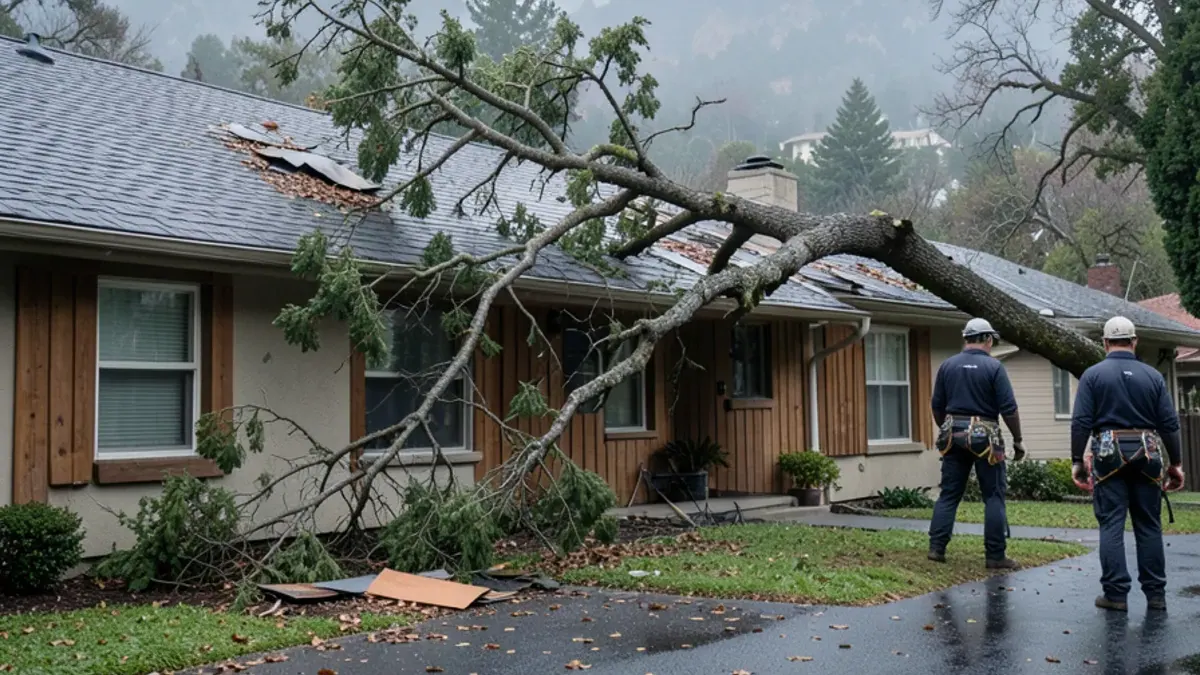
  • A branch or limb has punched through the roof.
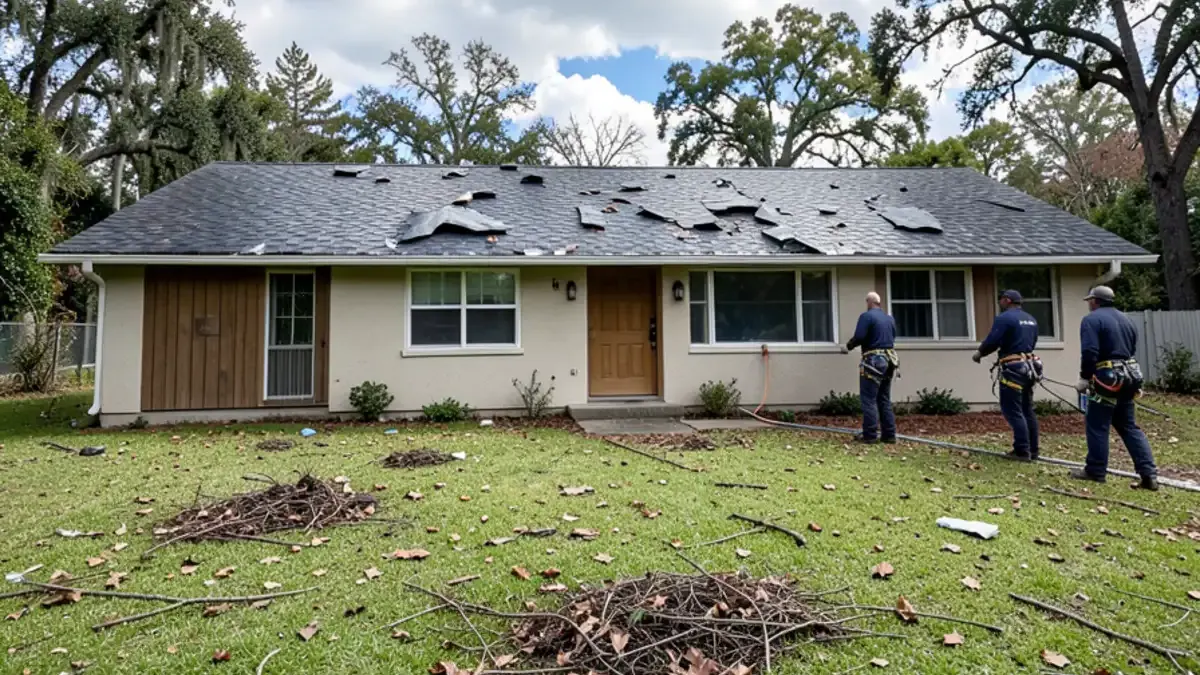
  • Wind has stripped a section of shingles or tiles down to underlayment or bare wood.
  • Fire, or the firefighting that followed, has opened part of the roof.
  • A leak is active, more rain is forecast within days, and the source can't be reached safely mid-storm.
  • An older roof has several leaks at once and a wider area needs cover until it is repaired or replaced.

A single lifted shingle or one cracked tile can often be sealed or swapped instead. Tarping a whole slope for a small problem adds cost and fasteners you don't need, and we'll tell you when that's the case.

Tarp roof after storm: what you can do safely from the ground

Homeowners can't tarp a roof safely in the rain, and we don't recommend trying. Ladders slide on soaked lawns, a tarp in a gust pulls like a sail, and shingles, tile and moss are slick. While you wait:

  1. Move people and valuables out of rooms below the damage.
  2. Catch drips, and switch off the breaker for any light or outlet getting wet.
  3. Photograph the roof from the yard or street, and the damage inside, before anything is covered.
  4. Open a clear path to the side yard and unlock the gate, so the crew can bring ladders straight to the damaged side.
  5. If a tree or limb is still on the house, read fallen tree roof damage first; the tree usually comes off before the tarp goes on.

Questions about emergency roof tarping?

Call first for the quickest answer, or request a free written estimate below.

Call (725) 745-8803

Request a free written estimate

Fastest answer: call (725) 745-8803. Or send the details below and we will call you back.

Roof tarp installation on shingle, tile and flat roofs

How a tarp is held down depends on what is underneath. The aim on every roof is the same: cover the damage with generous overlap, run the top edge over the ridge or tuck it uphill so water flows over the tarp rather than under it, and fasten it so wind can't get beneath.

Every tarping visit includes the same core work, whatever the roof:

  • Heavy-duty poly tarp sized to reach well past the damage on every side.
  • Battens or straps to hold the edges, chosen for the roof material.
  • Debris cleared from the opening first, so nothing sharp punctures the tarp from below.
  • Photos of the damage before cover and of the finished tarp after.
  • An interior check for new drips before the crew leaves.

Asphalt shingle roofs

Tarp edges are rolled around wood boards, and the boards are fastened through to the decking. Fasteners go in sparingly and, where possible, in areas the permanent repair will replace anyway, so good shingles aren't left with new holes.

Clay and concrete tile roofs

Tile cracks under careless footsteps, so the crew steps where tiles are supported and may lift a few to reach solid decking for fastening. On some tile roofs the tarp is weighted and strapped rather than screwed down. Expect a few tiles to be replaced at the permanent repair.

Flat and low-slope roofs

Water sits on a flat roof instead of running off, so the tarp is laid and weighted to drain toward the gutter or scupper, never to form a pond. Eichler-style roofs with exposed beams below need extra care with fastening.
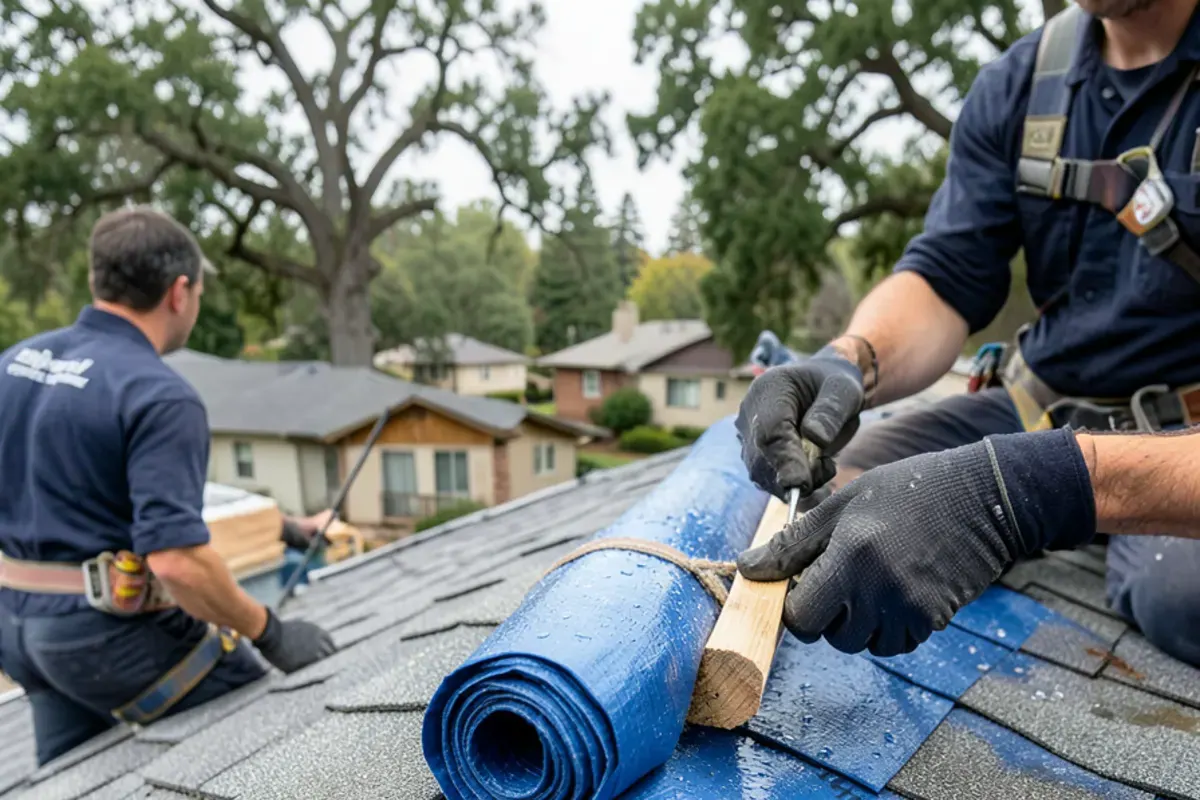
Tarp edge rolled around a wood board and fastened over asphalt shingles
A tarp edge rolled around a wood board and fastened over asphalt shingles to keep wind from lifting it.

How a tarp goes on, step by step

  1. Read the roof from the ground: pitch, material, wind direction and where a ladder can stand on firm footing.
  2. Anchor fall protection before anyone walks the slope.
  3. Clear and photograph the opening, removing loose shingles, tile shards and small branches.
  4. Lay the tarp from the eave up, carrying the top edge over the ridge or tucking it under an uphill course.
  5. Secure the edges with battens, straps or weights, keeping new holes to areas the repair will replace.
  6. Check inside and photograph the result, then book the dry-weather inspection.
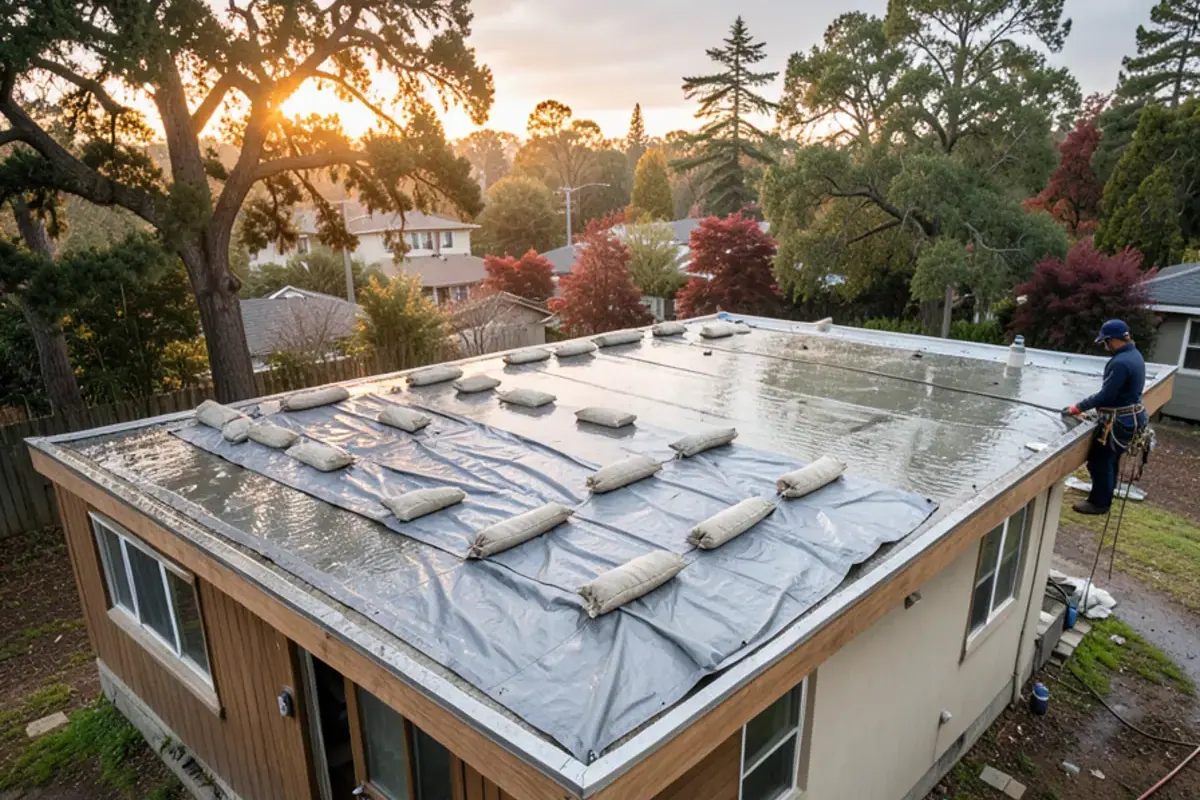
Gray tarp held down with rows of sandbags on a flat roof at sunset, a worker at the edge
A tarp on a low-slope roof held down with sandbags and sloped to drain toward the roof edge.

Emergency roof tarping in Campbell, CA: how a crew reaches you

We work from a Campbell base and cover Santa Clara County, the Santa Cruz Mountains and nearby parts of San Mateo and Alameda counties. Tarping calls are sorted by risk: open roofs over living space and active leaks come before damage that is still dry. There's no set response time. On the call you'll hear honestly when a crew can arrive, including when a wide storm has stacked up calls across the valley.

On arrival the crew looks over the house from the ground, photographs the damage before covering it, then installs the tarp. Before leaving, they check inside for new drips and share photos of the finished cover with you.

You deal with a family-run company from the first call to the final roof. The person who explains the tarp charge also writes the free, itemized estimate for the permanent repair, with photos of what sat under the tarp. Crews pick up shards and fasteners before leaving, and the photo set is ready to hand your insurer.
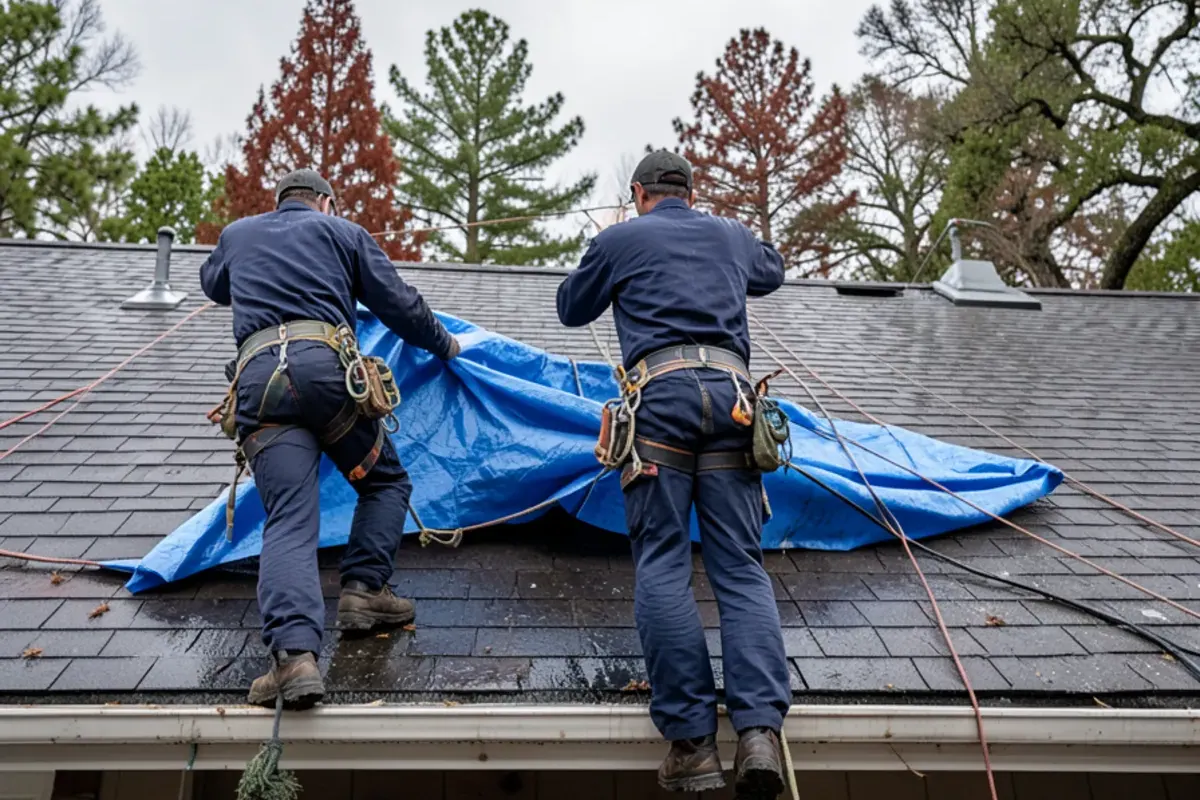
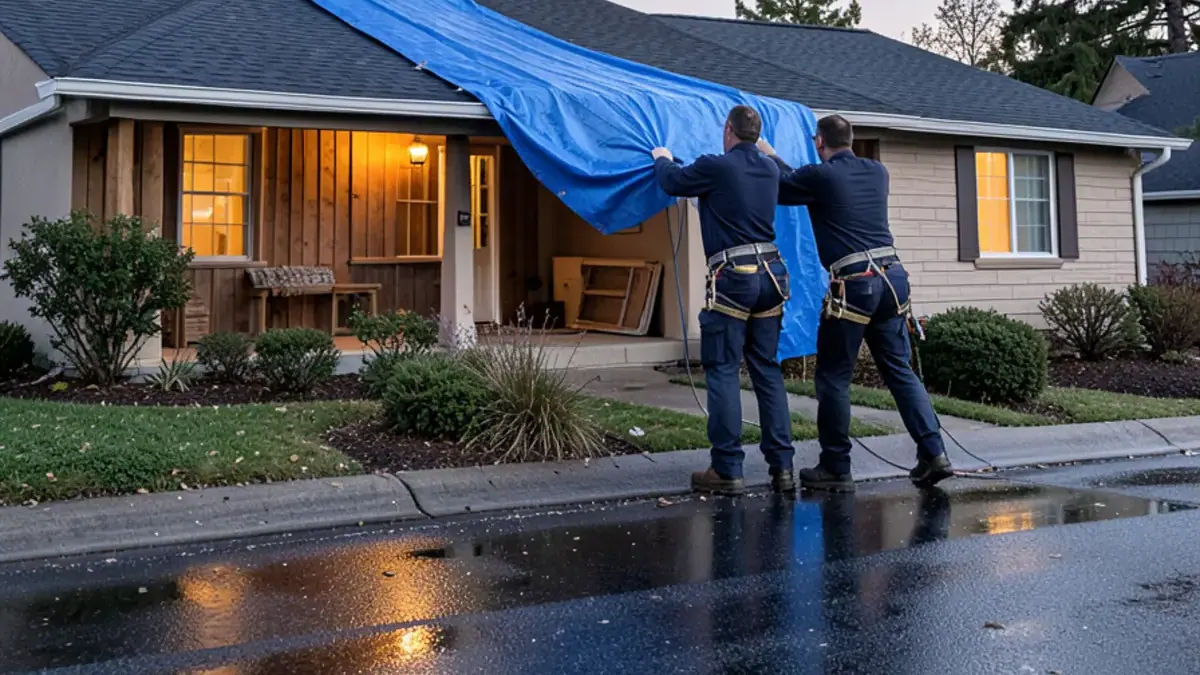
Two roofers in harnesses spreading a blue tarp across a wet shingle roof just above the gutter
Two roofers in harnesses spreading a tarp across a wet single-story shingle roof under gray skies.

Is a tarp enough, or does the roof need shrink wrap?

For most houses, a well-secured tarp is enough. Roof shrink wrap is a heat-sealed plastic film stretched tight over a whole roof or a large section. It is mostly used on large openings, commercial buildings, or fire-damaged roofs that will stay exposed for months while a claim and a rebuild are worked out. It costs more and takes longer to put on. If your roof calls for something other than a tarp, we'll explain why, and what it involves, before anything is ordered.

Temporary roof cover to permanent roof: the handoff

A tarp buys time; it isn't a repair. Poly tarps break down in sun and wind, and the South Bay's dry season brings strong UV the moment the rains end. Plan on weeks, not seasons.

Once the roof dries, we come back to remove the tarp, inspect what's beneath it and write an itemized estimate for the permanent fix. If the damage came from wind across the whole roof, that estimate follows the full inspection described under storm damage roof repair.
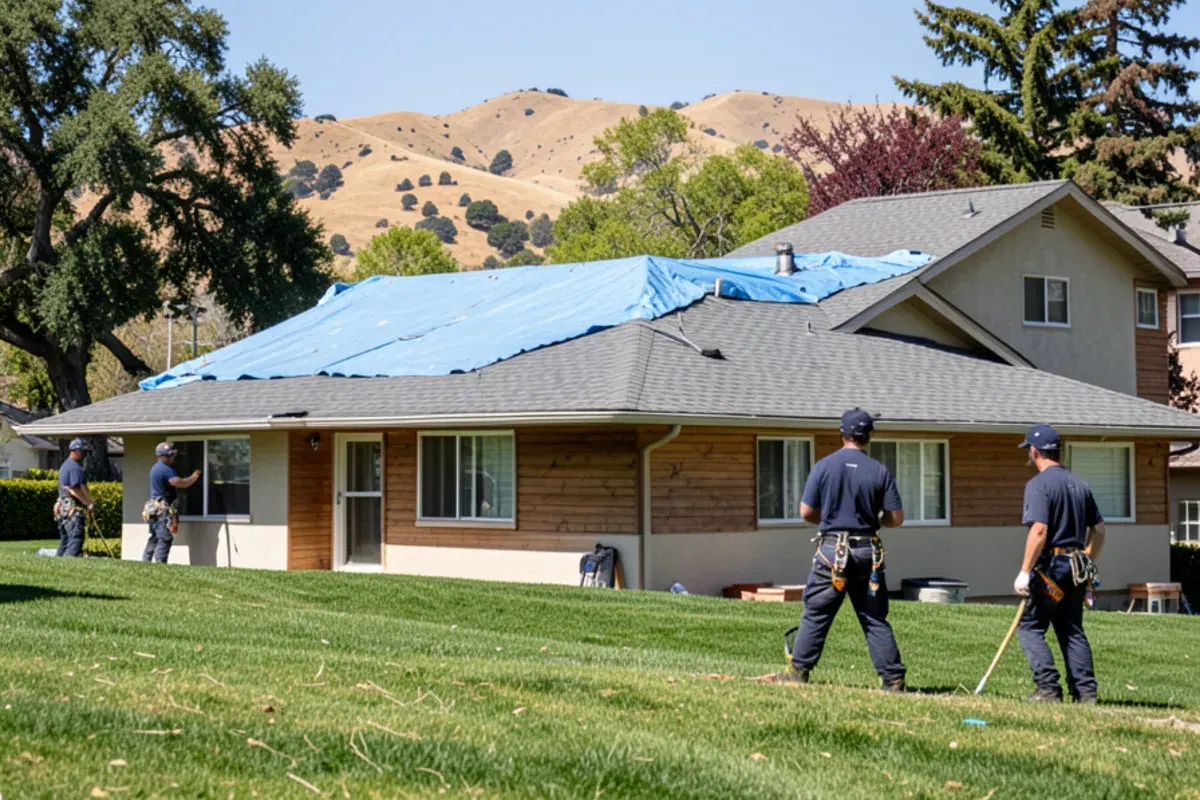
Blue tarp covering part of a single-story shingle roof under clear skies, with golden hills and four workers
A tarp still covering part of a shingle roof under clear skies as the hills turn golden.

Tarps, permits and who you let on the roof

A tarp is temporary protection, while the repair that replaces it follows normal permit rules. Inside Campbell that means the City Building Division; in unincorporated Santa Clara County, the County Planning and Development Department. Mountain towns differ: Scotts Valley issues its own permits, while Boulder Creek, Felton and Ben Lomond go through the County of Santa Cruz Planning Department. If a fire opened the roof and the house sits in a CAL FIRE mapped hazard zone, the rebuild needs a Class A roof assembly. Before anyone climbs up, check their CSLB license at cslb.ca.gov.

Tarp charges, explained before the ladder goes up

A tarping visit has a cost, and you'll know what it is before any work starts. It depends on:

  • Area to cover: a single opening or an entire slope.
  • Roof type and pitch: steep tile takes more time and care than a low shingle roof.
  • Access: two-story walls, tight side yards or a hillside lot in the mountains.
  • Return trips: re-securing after wind, and removal when the permanent repair begins.
  • Materials: a large slope or a two-story roof needs more tarp, battens and fasteners.
  • Time on the roof: tile and slate need slower, careful footing than shingles.

Keep the invoice and the photos. Insurers commonly ask for proof of what was done to prevent further damage.

Roof open to the rain? Call (725) 745-8803 for emergency tarping.

Call (725) 745-8803
Where we handle emergency roof tarping around Campbell

  • Boulder CreekBoulder Creek sits where Highways 9 and 236 meet, a long storm drive, so tarps there are fastened to last a whole storm series.
  • Bonny DoonRural Bonny Doon homes off Empire Grade are far from supply yards, so we load enough tarp and battens for the first trip.
  • CorralitosCorralitos farmhouses and barns on big lots in the apple hills often need wide covers over outbuildings as well as the house.
  • San MartinSan Martin ranchettes pair houses with metal-roofed barns, and a torn metal panel takes a different tarp method than shingle.
  • AthertonAtherton estates roofed in slate and clay tile need tarps strapped and weighted, since careless footing breaks pieces that are hard to replace.
  • HillsboroughHillsborough design review can apply to exterior changes, so a tarp buys time while matching slate, tile or shake is sourced.
  • WoodsideWooded Woodside properties toward Skyline Boulevard sit in fire zones, where a post-fire tarp holds until a Class A rebuild.
  • Los Altos HillsOne-acre Los Altos Hills lots can mean a long carry from the driveway, so ladder and tarp access is planned on the call.
  • San JoseAlmaden Valley tile tracts in San Jose need tarps laid over cracked tile without adding new breaks, often weighted rather than screwed.

What customers say on Google

64 Google reviews as of May 2026 · Read more reviews · Leave a review

“After a strong storm hit my house in Campbell, I needed a reliable roofer to handle the repairs. Luckily, my home inspector had previously recommended a trustworthy roofing company, and I decided to give them a call. Even though it was a tough time for roofers in the area with so many people needing help and materials being hard to get, Camden and the rest of the team kept me updated every week about when they could start and what to expect. Everyone I dealt with was professional and always ready to answer my questions. The roof repair was top-notch, and I decided to upgrade my gutters too because I felt confident that it would be worth it. I've had some bad experiences with other contractors before, but this roofing crew in Campbell really set the bar for quality work, great communication, and thorough cleanup. They also helped me through the insurance process, which made things so much easier. At the end of the job, the owner himself did a final walk-through to make sure everything was perfect. I would highly recommend this roofing company to anyone in need of roof repairs or upgrades. I'm still very happy with the results and grateful for their excellent service.”

Stacie B. · CampbellGoogle review · approx. Aug 2025

“After a big storm hit our area, Camden from Xylo Fix Roofers came out to check our roof right away and gave us an estimate very quickly. Once we had our insurance sorted out, they kept us updated about when the roofing materials would arrive and let us know what to expect throughout the process. The team worked fast and stayed late to remove all the old shingles, which had a huge number of nails holding them down. They made sure to come back at a time that was convenient for our family to finish up the job. Everyone was professional and respectful, and the whole roof replacement went smoothly. We’re very happy with the service and would definitely call them again for any roofing needs.”

Jody B.Google review · approx. Jul 2025

Emergency Roof Tarping: common questions

How long can a tarp stay on a roof?

Treat a tarp as cover for weeks, not months. Sun breaks down poly tarps, and every storm works at the fasteners and edges. In the South Bay, a tarp put on in January can hold through the wet season if it is checked, but by late spring the UV has taken its toll. We aim to replace it with the permanent repair as soon as the roof is dry and materials are in.

Will a tarp damage my shingles or tiles?

A well-installed tarp does little harm, though some is hard to avoid. Fasteners are kept few and placed where the permanent repair will replace material anyway. Tile is the touchy one: a few pieces may crack from foot traffic or be lifted for fastening, and those go on the repair estimate. A loose, flapping tarp does far more damage, which is why the edges are secured.

Does insurance pay for emergency tarping?

Frequently, when the damage behind it is covered. Most policies expect a homeowner to take reasonable steps to stop further damage, and tarping is the usual one. Whether and how much your insurer reimburses depends on your policy, so call them and keep our invoice and photos. We can't promise reimbursement, but the paperwork will show what was done and why.

Can I tarp the roof myself?

We don't recommend it during or right after a storm. Wet shingles, tile and moss are slick, a tarp in a gust pulls like a sail, and a fall from a ladder is far worse than any leak. If you want to help, work from the ground and indoors: catch water, move belongings, take photos. Leave the roof to a crew with harnesses and anchors.

What happens if wind loosens the tarp?

Call us. A tarp edge that starts flapping can tear itself and lift the shingles around it, so it's worth re-securing before the next storm. Don't climb up to fix it; take a photo from the ground so we can see which edge moved. A return visit to re-secure a tarp is explained like any other charge, before the work starts.

Do you tarp roofs after a fire?

Yes. After a fire, even a small one, a roof may be opened by flames or by firefighters venting it, leaving the house exposed to rain. A tarp protects what's left while you work with your insurer. Homes in the foothills and Santa Cruz Mountains that sit in CAL FIRE mapped hazard zones face extra rules for the rebuild, such as Class A roof assemblies, which the permanent estimate accounts for.

Related roofing services

Talk to a roofer about emergency roof tarping

Tell us what you are seeing. We will explain the options in plain terms and put the estimate in writing.

  • Family-run Campbell team
  • Free written estimates
  • 64 Google reviews
  • Insurance-claim photo documentation

Xylo Fix Roofers · 16135 E Mozart Ave, Campbell, CA 95008 · (725) 745-8803

Call NowFree Estimate