

Why the drip is rarely under the hole
On a low-slope commercial roof, water that gets through the membrane meets insulation boards and then the deck. It can run along the top of the insulation, follow the flutes of a metal deck, or soak a wide area of boards before finding a fastener hole or joint to drop through. In an office or retail space, it may then run along a duct, conduit or ceiling grid before the stain appears on a tile.
That is why leak calls that start with the question “what's above this tile?” often lead to a repair in the wrong place. A real investigation maps the interior, then works across the roof systematically.
Tenants reporting stained ceiling tiles? We trace the source on the roof, photograph it and document the repair for your records.
Call (725) 745-8803Leak sources by rooftop component
| Component | What fails | Typical repair |
|---|---|---|
| HVAC curbs | Curb flashing too short, split corners, open seams at the unit flange | Re-flash the curb to proper height; seal unit-to-curb joint |
| Pitch pockets | Filler shrinks and pulls away from pipes or supports | Refill, or replace with prefabricated boots |
| Parapet walls and coping | Open coping joints, cracked stucco, failed base flashing | Re-seal or replace coping; rebuild base flashing |
| Screen-wall and equipment supports | Posts and stands punched through the roof with minimal flashing | Proper flashed supports or curbs |
| Drains and scuppers | Clamping ring loose, membrane torn at the bowl, clogs causing overflow | Reset clamping ring, new target patch, clear and screen |
| Field seams | Lap seams opened by movement, heat or foot traffic | Clean and re-weld or re-seal seams |
| Pipe and conduit penetrations | Cracked boots, unsealed conduit added after the roof | New boots or flashing for each penetration |
| Skylights and roof hatches | Curb flashing and gaskets | Re-flash curb, replace gasket or unit |
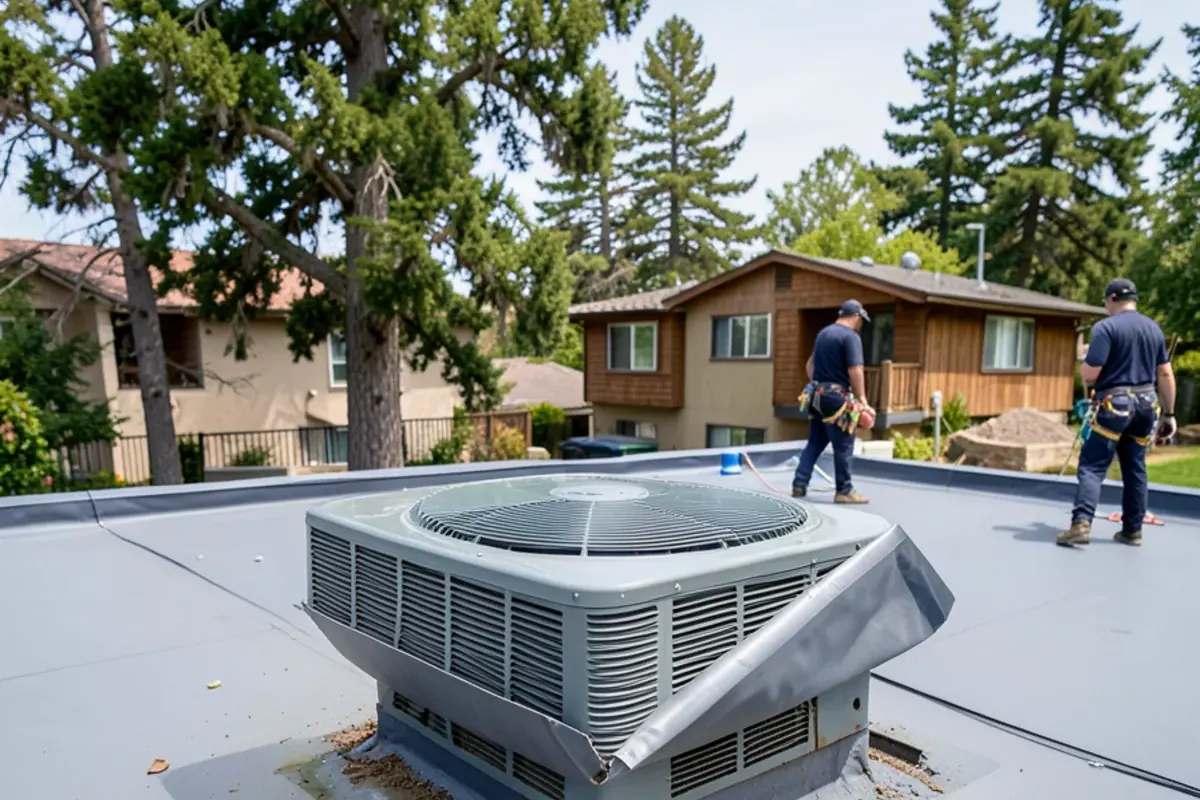
HVAC curb leaks and rooftop equipment
Rooftop units are the busiest part of a commercial roof. Service technicians walk around them, open panels, drop screws and sometimes cut in new lines. Condensate lines can spill onto the membrane. Curb flashing installed with the original roof often sits too low, so water backs over it when ponding forms on the uphill side.
Common fixes include raising and re-flashing the curb, adding a cricket on the uphill side, sealing the joint between the unit and curb, and routing condensate to a drain. Walk pads around units cut down on punctures from foot traffic.
Parapet and coping leaks
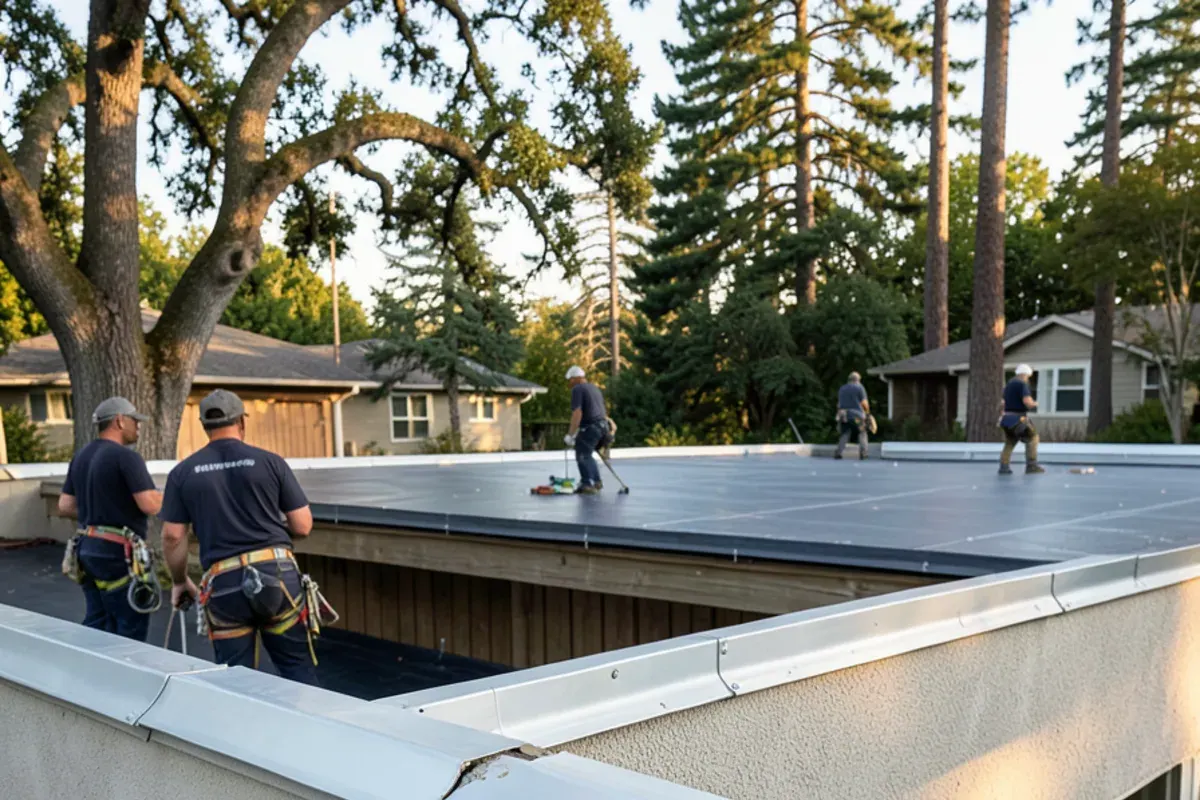
Parapets are walls that stick up above the roof edge. They take weather from both sides and from the top. Leaks here are tricky because water that enters through the coping cap or cracked wall finish can run down inside the wall and come out below the roof line, looking like a membrane leak.
- Open joints between coping sections let water into the wall top.
- Stucco cracks on the inside face channel water behind the base flashing.
- Base flashing that has shrunk or pulled away from the wall leaves a gap at the corner.
- Screen walls built later are often attached through the roof with thin flashing at each post.
Overflow drains and scuppers: when the backup plan is missing
Every parapet roof needs somewhere for water to go when the main drain clogs. The California Building Code calls for secondary, or emergency overflow, drains or scuppers wherever the roof edge would otherwise trap water if the primary drains back up. Sizing follows the plumbing code.
On older South Bay office and retail buildings, that backup is sometimes missing, blocked or set too high. When a primary drain plugs with leaves during a long storm, water keeps rising. If it reaches the top of the base flashing before it reaches an overflow, it pours into the wall or over the curb and shows up indoors far from any drain.
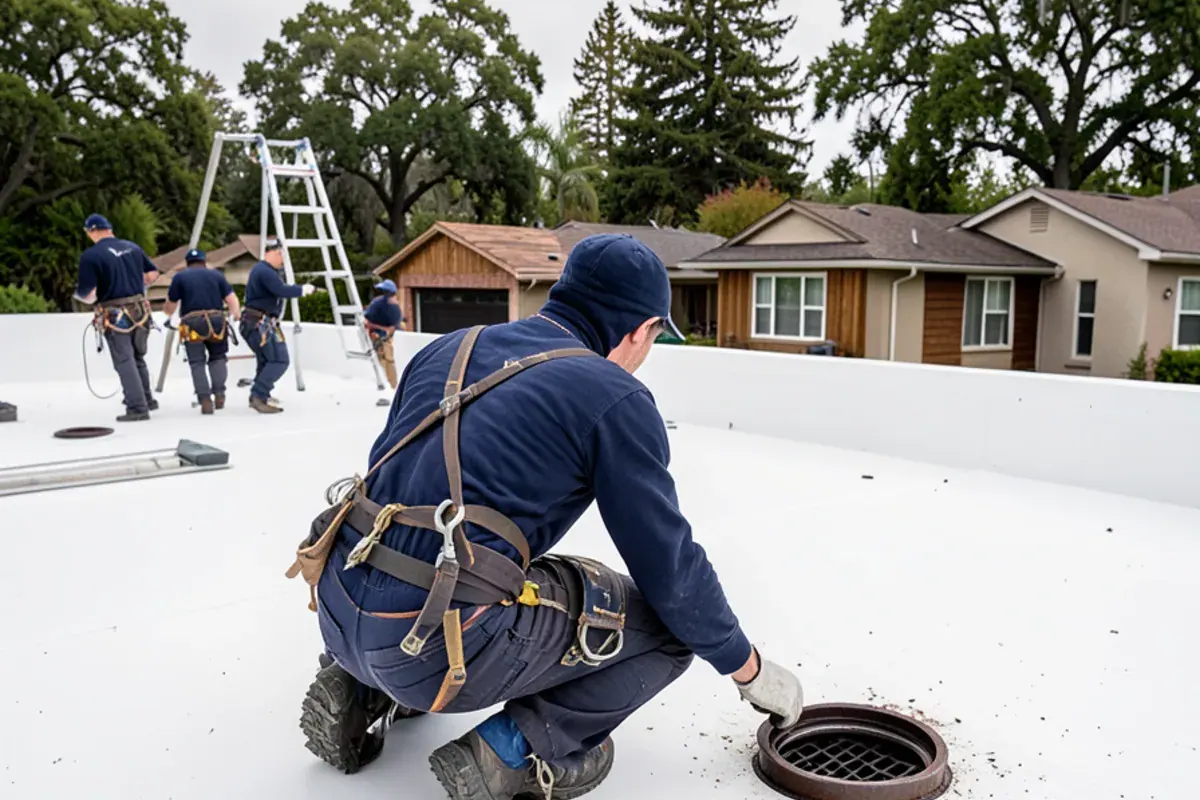
What to check at each drain and overflow
- The overflow opening sits a little above the low point near the primary drain, and well below the top of the base flashing.
- Base flashing along parapets and curbs stands tall enough; roofing industry guidance commonly calls for about 8 inches above the finished roof.
- Overflow scuppers are open, screened and discharge where falling water will not soak an entry or a wall below.
- Interior overflow drains, where used, run to their own outlet so you can see when they are working.
How commercial roof leak detection works, step by step
- Interview and map. Record where and when tenants see water, and whether it follows rain, wind direction or HVAC operation.
- Look above the ceiling. Lift tiles near the stain to follow water tracks along the deck, ducts and framing.
- Survey the roof. Inspect every curb, penetration, drain, seam and parapet in the area upslope of the interior stain.
- Probe and test. Check seams by hand, look for wet insulation, and run controlled water tests one detail at a time.
- Make the repair. Fix the confirmed source with materials compatible with the existing membrane.
- Document. Provide photos of the source and the repair for the owner, manager or insurer.
Some owners also commission moisture surveys, such as infrared or capacitance scans, to map wet insulation across a large roof. Those surveys help decide between targeted commercial roof repair and a broader reroof.
Finding wet insulation without tearing the roof apart
On a large roof, the stain inside may be one of several wet zones. Before deciding between a targeted repair and a reroof, it helps to know how much of the insulation is holding water. Three survey methods are common, and each is confirmed with a few small core cuts.
| Method | How it works | Limits |
|---|---|---|
| Infrared scan | Wet insulation holds the day's heat longer and glows warmer on an evening thermal image; ASTM C1153 describes the practice | Needs a sunny day followed by a clear, calm evening, and a dry roof surface |
| Capacitance or impedance meter | A handheld meter rolled over a grid reads moisture below the membrane | Slower on big roofs; readings must be checked against cores |
| Electronic leak detection | A low-voltage current finds breaks in the membrane where water completes the circuit; ASTM D7877 covers these methods | Works on some membranes and decks, not all |
Why wet insulation matters even after the leak stops
Soaked insulation boards lose most of their insulating value, add weight to the deck and can rust metal decking and fasteners from below. They also keep feeding water to the ceiling for days after a repair, which makes a fixed leak look like a failed one. Cutting out and replacing wet areas is part of a complete commercial roof repair.
From our roof visits: patterns on office and retail roofs
The most recent work on the roof is the first place we look. New conduit, a new antenna mount or a replaced HVAC unit often involves cutting the membrane, and the flashing at that spot is frequently an afterthought.
Clogged drains turn small defects into leaks. A seam that never sees standing water can last for years; the same seam under a pond after a clogged drain leaks in the first storm. Keeping drains clear is the cheapest leak prevention on any commercial roof.
Coatings can extend the life of a sound roof. Silicone and similar coatings are used on flat office roofs to renew the surface, but they belong on a roof whose leaks have been found and fixed first, not as a way to cover unknown problems.
Leak tracing on an occupied building comes with trade-offs we discuss with the manager first. Controlled water tests can wet a tenant's ceiling again, so we plan them with someone inside and schedule around business hours. Infrared surveys are cheap per square foot but depend on weather that is scarce in a South Bay winter. Core cuts give certain answers but each one has to be patched. Picking the right mix of methods keeps the investigation honest without disrupting the building more than needed.
What should property managers log between roof visits?
Good records shorten every leak investigation. For buildings around Campbell and Santa Clara, we suggest keeping:
- Dates and locations of every interior leak report, with photos.
- Weather at the time, including wind direction.
- Any rooftop work by other trades, with dates.
- Drain cleaning dates and what was removed.
- Past repairs, including membrane type and location.
A log like this, plus clear drains and working overflows, prevents more leak calls than any single repair. When a leak does appear, it lets the person on the roof start in the right place.
Need a leak traced on an office, retail or medical roof? Ask us for a source investigation with photos and a written repair scope.
Call (725) 745-8803